Thursday, March 17, 2011

CLEO Technology Sparks Controversy

(Left: Data points from Osram Opto Semiconductor of Germany. Lower black square at 142 lm/W demonstrating record white-light LED efficiency; second black square at 160 lm/W shows projected efficiency after further optimization.)

You may not think that LED lighting would be a controversial topic, but as the New York Times reports, it may be indirectly responsible for new anger among conservative lawmakers in the United States. A U.S. federal law passed in 2007 by the Bush administration will, among other energy-saving measures, make the sale of the incandescent 100-watt light bulbs illegal in 2012. Republican representatives Joe Barton of Texas and Michelle Bachmann of Minnesota, and Republican Senator Rand Paul of Kentucky have recently become vocal about the rights of Americans to purchase lighting of their choice (energy-efficient or not).

The alternatives to the more-than-a-century-old technology spurning this debate are a new make-over of halogens (not much more efficient than incandescent bulbs at about 20 lumens/W), compact fluorescent bulbs (about70 lumens/W), and LED lighting (Osram Opto Semiconductors of Germany just recently claimed to have set a record for warm-white LED chips at 142 lumens/W). CLEO attendees beware: might tea-party members be planning protests of sessions within CLEO Science and Innovation 15: LEDs, Photovoltaics and Energy-efficient ("green") Photonics?

The "controversial" talks related to LED lighting can be found specifically in sessions "Nano-structured LEDs" on Monday, May 2, 1:30-3:15 pm and "Toward More Efficient Visible LEDs" on Wednesday, May 4, 1:30-3:10 pm. Many of these talks will address specific problems in the overarching goal of fabricating highly-efficient LEDs that can simultaneously mimic the white-light spectrum of an incandescent light bulb. White-light LEDs could reach luminous efficiencies of greater than 300 lumens/W once certain device and fabrication challenges are overcome.1

One of the greater challenges is overcoming the emission gap in the green-yellow region of the visible spectrum (515-600 nm).1,2 Whether multiple LEDs of different color are combined to produce white-light, or one or two different colored LEDs are used to pump phosphors to produce white light, current designs lack efficient production of yellow-green photons for true white-light color (a stinging irony for a technology slated as "green" photonics). Invited talk, CMU5, "Nitride-based Nano-columns and Applications" and contributed paper CMU6, "Diffraction-Coupled Plasmon-Enhanced Light Emission from InGaN/GaN Quantum Wells" in session "Nano-structured LEDs"will show different approaches to generating green light using nano-structures on InGaN. Lowering the dimensionality by using nano-structures allows one to play with defect, strain, and polarization properties of the material and hence light generating capability and extraction.2

Another challenge being addressed in session "Toward More Efficient Visible LEDs" is "efficiency droop" particular to InGaN. InGaN LEDs show great promise at low currents, but suffer an enormous efficiency reduction (the droop) at high-current injection, a problem for potential use in high-power applications. The jury is still out on the cause for the droop.2 Contributed paper CWF3, "On the symmetry of efficiency-versus-carrier-concentration curves in GaInN/GaN light-emitting diodes and relation to droop-causing mechanisms" will be presenting evidence in support of carrier-leakage theory for droop. Contributed paper CWF4 "Efficiency Droop Reduction in InGaN/GaN Light-emitting Diodes by Graded-thickness Multiple Quantum Wells" will show work demonstrating droop reduction by inserting clever nano-structures into the design.

Whether or not you personally believe you should have the right to buy old-tech, 100-Watt incandescent light bulbs, one thing that is not a controversy is that LED technology is hot. It will likely be the future of lighting for illumination and displays. Don't miss out on these talks.

References

1. E Schubert and J.K. Kim, "Solid-State Light Sources Getting Smart," Science, 308, 1274-1278, (2005).

2. M. Crawford, "LEDs for Solid-State Lighting: Performance Challenges and Recent Advances," J. Sel. Topics in Quant. Electron., 15,
1028-1040, (2009).

Monday, March 14, 2011

Thoughts go out to our Japanese Colleagues

I know I am not alone when I write that my thoughts go out to our Japanese colleagues, collaborators, and friends as they cope with the aftermath of the March 11, earthquake and tsunami. The field of optics has a rich history of Japanese innovation. CLEO habitually hosts a significant number of contributed papers, tutorials, short courses, and plenary talks from Japanese scientists or those with ties to Japanese universities or companies. I hope for the safety and health of the survivors of this horrific disaster, and for what it may be worth, offer condolences to those who lost friends, family and loved-ones.

I am optimistic that the recent crises involving nuclear reactors will be solved without further disaster. My experience with Japanese technology and expertise is that it is thoughtful, long-term, and state-of-the-art. If anyone can come up with the right solution, it is them.

Friday, March 4, 2011

James Bond meets CLEO


(Above: From LLNL, Artist's concept of the MEGa-ray system)

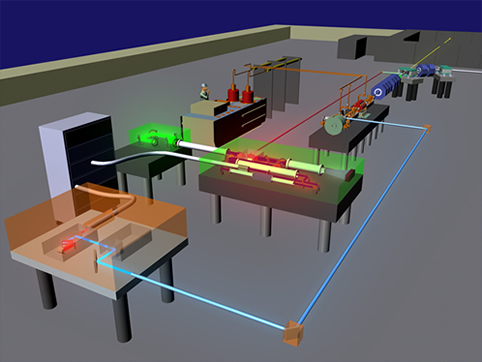
The conference program for CLEO 2011 was just released on Wednesday, March 2. Among many other cutting-edge and ground-breaking contributed papers are those from the new conference to debut this May, CLEO: Applications and Technology. Browsing the topic subcategory, Lasers for Government Science and Security Applications, I came across titles that seemed to be the stuff out of a James Bond movie, ATuF2, "Mono-Energetic Gamma-rays (MEGa-rays) and the Dawn of Nuclear Photonics" and ATuF4, "2D+3D Face Imaging for Stand-off Biometric Identification." Can't you just picture the mad, evil-scientist-villain (disfigured in some way, stroking his cat) plotting to steal a MEGa-Ray device in one scene, and Q 3D-scanning 007's face in order for him to gain access into MI6 in another? Maybe I need to do more optics research and watch less movies, however, there's no question about impact of these papers.

Last February, David Gibson, Christopher Barty and colleagues at the National Ignition Facility and Photon Science Division at Lawrence Livermore National Laboratory (LLNL) published their initial results on a MEGa-Ray source they constructed as groundwork for a beefier machine (2 MeV) in the future. At 2 MeV, such a narrow-bandwidth, high-energy, x-ray source could provide brightness 15 orders of magnitude greater than those produced by synchotrons. The artist rendition of the facility shown in the figure above demonstrates the compact size (a large room) compared to the kilometer-scale rings or linacs conventionally used for generating high energy x-ray beams. Additionally, x-rays of this energy and brightness will find use in nuclear physics and applications such as detection of concealed nuclear material or specific isotope detection and quantification.

So how do you make a MEGa-Ray? By scattering high-intensity laser photons off of a relativistic electron beam (Compton Scattering). In fact, the relativistic electrons are made with a laser as well. The group at LLNL uses matched fiber laser oscillators and fiber-based amplifiers to make the relativistic electrons and the high-intensity scattering light to produce the end product.

Brian Redman from Lockheed Martin and his collaborators, on the other hand, are using light in a very different way- to scan human faces for secure identification and threat-detection. Biometric identification refers to a technique in which a subject can be identified by a unique physical trait or something they physically produce. Some examples are fingerprinting, iris scans, facial scans, and analysis of gait. This topic is particular fascinating to me since human identification is something that the human brain does remarkably well, and for which computers often have trouble. We can identify another person with a great success rate from a far distance based on how they walk, their gait (for a fun gait simulator click here). We have an impeccable ability to identify faces, particularly when we are young- babies can recognize different monkey faces. Therefore one of the directions of research on biometric identification is to improve computational algorithms.

One of Lockheed's specific objectives in their partnership with the FBI is to build a database of facial scans analogous to their database of fingerprints, the Integrated Automated Fingerprint Identification System (IAFIS). I look forward to hearing how Dr. Redman's CLEO talk addresses the optics involved in the facial scans, the use of both 2D and 3D scan information, and the success of the algorithms employed.

Wednesday, February 23, 2011

Femtomagnetism and Phototherapy

(Left: Schematic of pump-probe experiment to investigate femtosecond time-scale demagnetization on a magnetic film; from Bigot et al., Nature, 465, 458 (2010).)

As we await decisions on contributed papers in the next couple of weeks and for the technical program to be scheduled, the list of tutorials and invited talks for CLEO 2011 is rounding out. Two provoking titles that recently caught my eye were tutorial talks "Femtomagnetism" to be given by Jean-Yves Bigot from CNRS in Strasbourg, France under CLEO: QELS Fundamental Science 4: Optical Interactions with Condensed Matter and Ultrafast Phenomena as well as "Therapeutic Applications of Light: Photodynamic Therapy, the Killer and Low Level Light Therapy, the Healer" to be given by Michael Hamblin from Massachusetts General Hospital, under CLEO: Applications & Technology 1: Biomedical.

Femtomagnetism refers to magnetization dynamics which occur on a femtosecond time-scale. Over the last decade, Dr. Bigot and his colleagues have been using ultrafast laser pulses to induce changes in the magnetization of ferromagnetic materials on unprecedented time-scales. Besides probing the fundamental nature of magnetism, this work provides insight into the future of magnetic data storage, particularly finding a way to increase the speed of recording data. A ground breaking paper Phys Rev Lett. in 2007, by Stanciu et al. showed how the previously-thought fundamental speed limit to magnetic data recording could be broken by using ultrafast laser pulses to reverse the magnetization of magnetic bits during writing.

In a recent Nature article, Bigot et al. describe short time-scale, spin-orbit dynamics during femtosecond, laser-induced demagnetization. Using a femtosecond pump pulse to quickly demagnetize a ferromagnetic thin-film immersed in a magnetic field, Bigot and his collaborators extract information about the spin and orbital angular momentum as a function of time in a cross-correlation technique using x-ray pulses (See Fig.1). Spin and orbital angular momentum contributions during the process are measured by time-resolved x-ray magnetic circular dichroism (XMCD), a technique in which circularly polarized x-rays absorb in different proportions at different energies depending on the spin and orbital angular contributions of the material. This recent work investigates the magnetism dynamics in thin films whose magnetization is perpendicular to the plane of the film- a class of materials sought after for high-density data storage, and for which spin-orbit coupling plays a large role.

After reading some background on this fascinating and complex work, I was reminded of a famous interview with Richard Fenynman where a BBC reporter asks him to explain magnetism (click here to see the youtube clip). In Feynman's clever way he basically tells the reporter he can't do it because there is nothing in the reporter's sphere of knowledge and experience that would help him understand. Magnetism is beautiful, complicated, and at the fundamental quantum level, extremely non-intuitive (you really can't get by on analogies of spinning tops and orbitting planets, that's just plain wrong). If like me, you need some background, a good start is Bigot's 2002 review paper. Of course, why not hear it from the horses mouth and mark the tutorial on your conference planner.


(Above: plots showing enhanced cellular uptake of the photosensitizer ZnPc-(Lys) compared with other sensitizers, and corresponding images of cells; from Hamblin et al., ChemMedChem, 5, 890, (2010).)

Professor Hamblin's work on the other hand uses light in a very different way- to activate chemicals that can target and selectively kill harmful cells like infectious microbes or malignant cancer cells (photodynamic therapy), as well as to activate the production of intrinsic detoxifying chemicals within damaed cells to stimulate tissue healing (low level light therapy). In photodynamic therapy (PDT), photosensitizers are introduced into the body locally or topically and taken-up by the harmful cells. Illuminating the targeted cells with light excites the photosensitizers and produces reactive oxygen species harmful to the targeted cell.


(Above: Table showing inhibition of tumor growth when using photodynamic therapy with ZnPc-(Lys) ; from Hamblin et al., ChemMedChem, 5, 890, (2010).)

One of the aims of Hamblin's group is to create more efficient photosensitizers- ones that are more readily taken up by targeted cells and that are more lethal. Hamblin recently synthesized a photosensitizer, Pentalysine Beta-Carbonylphthalocyanine Zinc (ZnPc-(Lys)), that showed better cellular up-take, better selectivity to targeted cells, and a 20 times increase in photo-toxicity. Figure 2. shows the increase in uptake compared to conventional sensitizers and Table 1. shows the results of tumor-growth inhibition in Kunningmig mice that were treated with PDT using ZnPC-(Lys). For more information on killing and healing power of light, visit Professor Hamblin's very accessible and informative web pages. Better yet, be sure to attend the tutorial on phototherapy!


Thursday, January 27, 2011

Stand Up and Clap if you Love Science!


(Above: U.S. President, Barack Obama, following-up his state-of-the-union message at energy technology firm Orion Energy Systems in Manitowok, WI on January 26. Photo from Orion Energy Systems)

Just this past Tuesday, U.S. president, Barack Obama, invoked science and innovation in the State-of-the-Union-Address, as the silver bullet to heal an ailing U.S. economy and crumbling infrastructure. U.S. statesmen and -women alike got up out of their seats repeatedly to give applause for science. Specifically, Mr. Obama, cited three optics-related areas of research to which he will try to allocate U.S. federal funding: 1) biomedical research, 2) information technology, and 3) clean-energy technology. Mr. Obama proposed to send a budget to congress in the next few weeks that would help the U.S. "...reach a level of research and development we haven’t seen since the height of the Space Race." To that aim, CLEO will be hosting contributed papers in these three areas, and if Mr. Obama is successful in his budget requests, perhaps we will be seeing more submissions and exhibitions in these fields in the near-future.

Entire sessions devoted to Obama's first research area, biomedical research, can be found under two-topic categories CLEO:Applications and Technology 1: Biomedical and CLEO: Science and Innovation10: Biophotonics and Optofluidics. The former will contain research already in the clinical-trial stage, whereas the latter will hold emerging research that is "pre-pilot." One of the many sub-categories in these topics includes optical biopsy. The goal of optical biopsy is to diagnose tissue during a medical procedure in vivo with photons rather than extracting it invasively with a knife (to be analyzed later in a lab). This is the aim of many biomedical techniques such as diffuse optical tomography (DOT), optical coherence tomography (OCT), and multiphoton microscopy (MPM). These techniques use light in clever ways to extract information from deep inside tissue which typically scatters away all the light you want. Be sure to attend these sessions for the latest on these and other emerging biomedical techniques.

Sessions for Mr. Obama's second research area, information technology, can be found under topic categories CLEO: Science and Innovation 12: Lightwave Communication and Optical Networking, CLEO Symposium on Quantum Communications, and CLEO: Science and Innovation 9: Components, Integration, Interconnects and Signal Processing. One of the invited talks in the special Symposium on Quantum Communications will be from Masahide Sasaki of NICT, regarding the Tokyo Quantum Key Distribution (QKD) Network. Just this past October, a secure video (a record megabit per second data rate using QKD) was demonstrated over the Tokyo QKD Network at the Updating Quantum Cryptography and Communications conference. Be sure to attend Dr. Sasaki's talk on the current and future state of secure photonic networks.

Finally, sessions regarding Mr. Obama's third area of research, clean-energy technology, can be found under topic categories CLEO: Science and Innovation 15: LEDs, Photovoltaics, and Energy-efficient ("Green") Photonics, and CLEO: Applications and Technology 2: Environment and Energy. One of the sub-categories, photovoltaics, will be discussed at the research stage in the first category, and their practical production and implementation in the second. Some of the issues concerning photovoltaics are reducing production cost while increasing power conversion efficiency. Simple silicon is cheap, but only gives efficiencies in the range of 10-18% for ambient sunlight. Using tricks to expand the spectral response in the UV and infrared can be done by incorporating multiple materials. Concentrix of Germany, manufactures a triple-junction cell (GaInP/GaInAs/Ge) that produces efficiencies up to 38%. Production is more expensive than a single silicon p-n junction, however, by incorporating a Fresnel lens on the surface, less material is needed, and cost can be significantly lowered (see Nature Photonics, "Concentrating on the Future") . Other tricks to up efficiencies can be used such as "quantum-cutting" (either down-converting UV light into redder light or using two-photon absorption of infrared photons), texturizing the surface to minimize reflection, or incorporating nanostructures to increase light harnessing capability through plasmon response (see Nature Photonics, "Sunny Outlook"). Come to these sessions to learn about the latest research, not just in photovoltaics, but in other areas of "green" photonics. If Mr. Obama has his way "by 2035, 80 percent of America’s electricity will come from clean energy sources." If the U.S. reaches this goal, it will be the very technology presented at CLEO that will have brought us there.

Thursday, December 30, 2010

Fiber-to-the-home and Science Innovation

(Left: Fiber-to-the-home converter box at my mother-in-law's rural Wisconsin home. The optical signal is converted into an electrical signal at the box and then routed into the house. The black cable is the input optical fiber bundle; if you squint, you can make out some additional yellow-jacket, fiber patch-cords through an opening at the base of the box.)

Like usual, this Christmas holiday my family and I spent some time at my mother-in-law's rural home in Spring Valley, Wisconsin enjoying good food, fresh air, and the escape from the confines and bustle of city-living. However, what was different about this year's visit was her home's new Terabit/s capacity for current and future digital communication and entertainment needs. My mother-in-law lives in one of six million American homes that currently have Fiber-to-the-home (FTTH) connectivity.

Her service provider, West Wisconsin Telecom Cooperative, is part of a growing number of American rural telecoms and municipalities surpassing their urban counterparts in the future of lightwave communications. Much of this rural technological growth has been made possible through grants and low-interest loans from the United States Department of Agriculture (USDA) Rural Utility Service (RUS) Telecommunications Program whose aim is to improve education, health, and economic opportunities of rural families and businesses through broadband internet access.


(Above: The neighbor's farm across the street .)

Seeing and using FTTH in person at my mother-in-law's got me excited about its implications on photonics research and applications, and science in general. Though CLEO is not a telecom- centered conference like OFC (optical fiber communications conference), there is much that fundamental science and optics research can leverage from telecom technology and visa-versa. The growth in one field breeds growth in the other. For a nice paper about the symbiotic relationship between great physics discoveries and advances in telecommunications technology, see Brinkman and Lang's 1999 Reviews of Modern Physics paper "Physics and the Communications Industry."

Though I may be biased towards fiber-based technologies, to me the links between work presented at CLEO and the growth of telecom is pervasive. For starters, the first CLEO plenary speaker, Donald Keck, will share stories of how his team at Corning pioneered the first usable low-loss fiber in 1970 and discuss its place in the broader context of the ensuing optical technology and information revolution. The exciting history of bringing down the loss of optical fiber (which in its infancy was an opaque 1000 dB/km) involves a Nobel prize (Charles Kao correclty hypothesized the bottleneck to transparency) and the development of the groundbreaking fabrication technique of modified chemical vapor deposition (MCVD) by John MacChesney's team at Bell Labs, which brought loss down to what it is today.

As Keck will likely discuss, making fiber transparent paved the way not only for a host of other telecom and information technologies but new fields of photonics. For communications, once you have an acceptable waveguide, you still need sources, modulators, detectors, amplifiers, routers, multiplexers, switches. For the most recent breakthoughs in telecom be sure to attend CLEO: Science and Innovation 12: Lightwave Communication and Optical Networking.

Naturally, the field of quantum communications is tied up in current telecom technology. CLEO Symposium on Quantum Communications will host papers in both fundamental science research in quantum information and actual quantum communication testbeds- fiber-based and free-space.

You can find telecom-derived technology in CLEO: Science and Innovation 11: Fiber Amplifiers Lasers and Devices. This session includes topics such as CW and pulsed mode-locked fiber oscillators, amplification in doped fibers, ultra-wideband fiber amplifiers, Raman amplifiers, coherent and incoherent combination of fiber lasers and amplifiers, fiber-based nonlinear effects, fiber-grating and microstructured fiber devices. The applications for these technologies range from spectroscopy, biomedical imaging, and materials processing.


(Above: Sign marking the location of buried fiber)

My excitement at my mother-in-law's FTTH led to some disappointment about the speed of her computer (any computer for that matter). She has ~100 Tb/s capacity, but only ~Gb/s capability. To get the capability you need to move to all-optical signal processing and optical computing. CLEO will host a variety of sessions regarding or related to this important technological goal. See CLEO-QELS Fundamental Science 6: Nano-optics and plasmonics; CLEO: Science and Innovation 7: Nano-optics Micro- and Nano-photonic devices; and CLEO: Science and Innovation 9: Components, Integration, Interconnects and Signal Processing. Among other ground-breaking research, I anticipate contributed papers from the Cornell Nanophotonic's Group whose P.I., Michal Lipson, recently received a MacArthur Genius Award , ($500k no strings attached) for her pioneering work in silicon-based circuits for practical optical computing.

The list of sessions at CLEO inspired by optical fiber and telecom technology goes on. One of my hopes for 2011 is to witness FTTH to more of the country, rural and urban. This isn't just job security for us all, but may prove pivotal to the growth and expansion of innovation in optics and science.

Tuesday, November 23, 2010

Emerging THz technology could solve body-scanner controversy

Above: From TeraView press release Jan. 2010, THz Spectra of explosives (threats) and different clothing materials (non-threats).

Today, the day before Thanksgiving, is one of the busiest holidays for air-travel in the U.S. The latest hubbub in U.S. airport security is the use of x-ray body scanners to detect for potential explosives or weapons carried by passengers. The scanners spray the traveler with soft x-rays and then detect the back-scattered radiation to produce an image of the passenger, minus his or her clothing. Many travelers have found this new level of security too invasive and have opted out for the traditional pat-down. Others have used their experience as the "butt" of jokes; Humorist Dave Barry recently described his ordeal of going through airport security of having both the scan and a pat-down due to a "blurry groin area" from the image. The threat of body-scanner boycotts from various websites and blogs prompted transportation security administration (TSA) chief John Pistole to plead to holiday-travelers to put security needs above personal modesty since the pat-down takes much longer and will lead to travel delays, inconvenience, and economic hardship for the travel industry.

The first thing that came to my mind in the flurry of stories I've been hearing regarding body-scanners and privacy issues was Terahertz (THz) radiation. Though I don't remember the particular conference, I still have the images in my head from a THz radiation talk not long after the Columbia Space Shuttle disaster in 2003 of space-shuttle foam and a body-scan. The presenters were using these images to motivate the applications of THz radiation for imaging- the THz image of the foam as a nondestructive technique to look at the structural integrity of shuttle foam, and the THz image of a body-scan as a better control of threat-detection in airports. Thz radiation was a budding field at this time and has since exploded. Last CLEO conference there were nine different sessions involving THz research and applications. Sessions ranged from new THz sources and detectors to THz waveguides and metamaterials. At the 2010 postdealine session, Xi-Cheng Zhang's group of Rensselaer Polytechnic Institute (likely the same group whose space shuttle foam and body-scan I remember from 2003) presented a paper on remote sensing using broadband THz sources.

One of the reasons the 2003 images stuck in my head was that the body-scan model was wearing what I assumed to be some kind of metallic underwear. What makes THz radiation useful for a body-scan is that it is readily transmitted through non-metallic and non-polar materials like clothing. Obviously the model for this research shared the same concerns as many current U.S. travelers. However, there is more to THz imaging than just seeing through clothing which could make THz scanners both a more effective and less invasive tool than x-ray scanners.

Unlike x-rays, there are a number of explosive, chemical, and biological agents of interest for threat-detection that have characteristic THz spectra1, including PETN which was found in the "underwear bomber's" briefs after his foiled attempt to blow-up a plane near Detroit last Christmas. Rather than build up an image of the body and rely on the scanner operator to judge the potential threat from visual inspection, a THz scanner could look at the reflected spectra point-by-point to compile a molecular fingerprint by comparing to a database of absorbance spectra. Effectively, this technique is "THz spectroscopy through clothing". You build up a chemical map across the body instead of a body image. TeraView of Cambridge announced work on such a scanner last January when the U.K. ran into similar passenger discontent over x-ray body-scans. Besides giving travelers back their modesty, this technique likely could give better threat detection as well as less false-positives since threats are identified chemically instead of visually.

To find the latest breakthroughs on THz scanners, be sure to attend sessions under CLEO: Science & Innovation: Terahertz Technologies and Applications, or CLEO: Applications & Technology: Government & National Science, Security & Standards Applications this May. Until then, have happy, safe, and hopefully noninvasive travels.

References

1. J. F. Federici et al., "THz imaging and sensing for security applications-explosives, weapons, and drugs," Semicond. Sci. Technol., 20, S266-S280, (2005).